

REGO-FIX powRgrip®
Fast, safe, precise – REGO-FIX toolholding systems in use at Burckhardt Compression
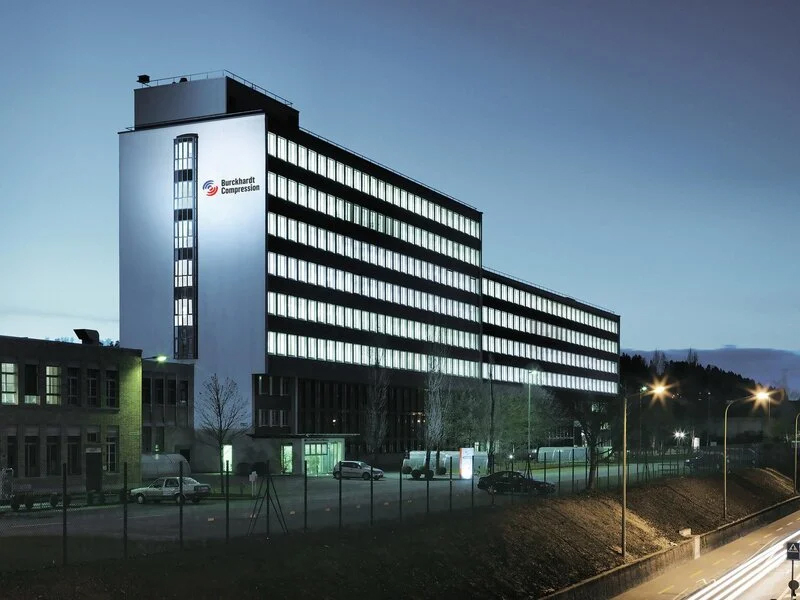
Burckhardt Compression, headquartered in Winterthur, Switzerland, has stood for technological excellence in gas compression for over 180 years. The company operates in more than 80 countries worldwide, employs around 3,300 people, and develops highly specialized reciprocating compressor systems for demanding applications—from petrochemicals and industrial gases to hydrogen mobility. In addition to the new machine business of the System Division (SYST), the Service Division (SERV) in particular plays a central role: the focus here is on maximum availability, short response times, and the highest level of reliability.
Demanding materials and time pressure
It is precisely in this environment that Remo Knecht operates—shift supervisor, CNC operator, and programming specialist at Burckhardt Compression. He has been with the company since 2018 and is responsible, among other things, for the production of wear parts such as valve components in the spare parts business. “Our components are often safety-critical and must withstand high pressures. At the same time, we frequently work under time pressure in the service business, as downtime at the customer must be avoided at all costs,” explains Knecht.
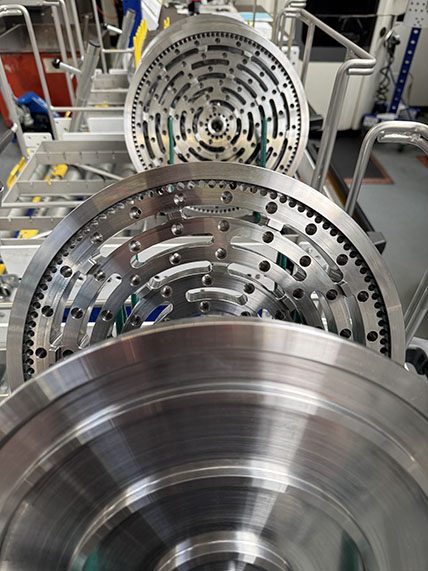
The requirements for machining are correspondingly high. The primary materials used are high-alloy, wear-resistant steels such as 1.4005, 1.4418, and 1.4571. These materials are considered tough and challenging to machine. Precision and process reliability, combined with short lead times, are essential.
Focus: Fast and secure
A key lever for optimizing production was toolholding. Previously, Burckhardt Compression’s Service Division (SERV) relied on shrink-fit technology. Still, this method came with clear disadvantages: significant time required for tool changes, waiting times due to cooling phases, and additional safety requirements when handling heat. “When all stations were occupied, it could take up to five minutes before a tool was ready for use again,” Knecht recalls.
The powRgrip® system is based on a purely mechanical press-fit process in which the tool is clamped into the collet without heat. The result: high runout accuracy, maximum clamping force and significantly simplified handling. “Tool changes are fast, safe, and repeatable. Issues such as heat or cooling times are a thing of the past,” says Knecht. Employee satisfaction has also improved noticeably, not least because protective gloves are no longer required.
Optimal clamping for a variety of tools
In daily use, a wide range of tools are clamped: from end mills in the Ø3 to 12 mm range to slotting and special tools as well as taper and radius end mills. Most of these tools are clamped in the powRgrip® system using PG 25 holders. Both standard collets and PG-CF variants with integrated cooling channels are used to ensure optimal coolant delivery to the cutting edge, even for tools without internal coolant supply. For drilling operations, the ER system is mainly used, particularly in combination with sealing disks for internal coolant supply. For deep hole drills, the powRgrip® system is preferred for stability reasons. This combination provides maximum flexibility while maintaining high process reliability.
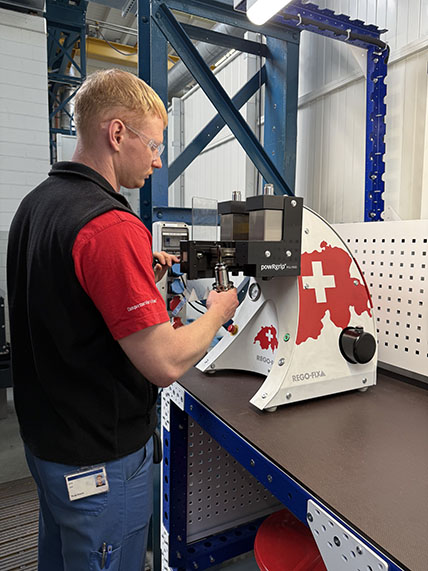
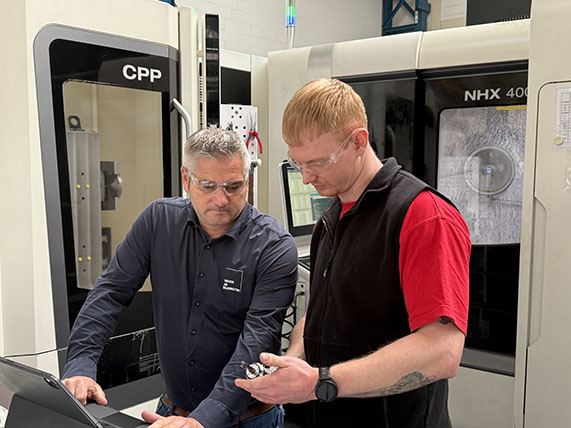
Remo Knecht, shift supervisor at Burckhardt Compression, clamping a tool into a powRgrip® toolholder. Image: Vischer & Bolli AG
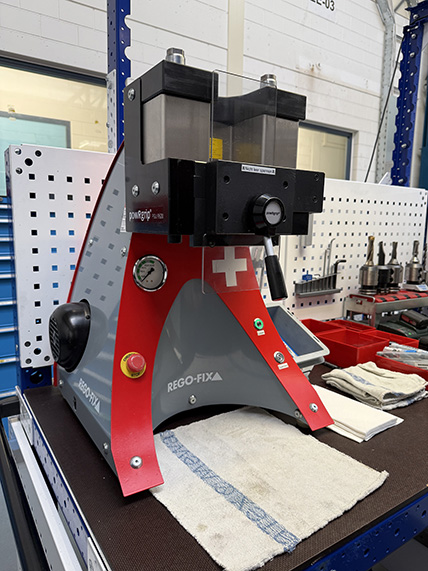
The powRgrip® clamping unit on the first production line.
Image: Vischer & Bolli AG
Tool clamping as part of the lean strategy
Another key driver for the introduction of the powRgrip® system was the consistent alignment of production with lean manufacturing principles. The objective was to simplify processes from the customer’s perspective, introduce flow and pull principles, reduce lead times, and at the same time increase flexibility within the Service Division (SERV), all with strong employee involvement. In this context, milling was defined as the central pacemaker process, with all components passing through this stage and thereby setting the rhythm for the entire production flow.
Standardized and optimized by machinists
A key element of the implementation is the first-in, first-out (FIFO) principle, which ensures transparency and consistent material flow. At the same time, great importance was placed on standardizing all workstations. Uniform toolholding systems such as powRgrip® make a significant contribution here, as they enable identical setup processes in milling operations, thereby increasing comparability and repeatability.
However, standardization goes beyond technology alone: setup workstations were also standardized so that tools can be prepared according to the same principles regardless of machine or machining process. This not only reduces sources of error but also enables flexible deployment of personnel, a decisive advantage in an environment characterized by high dynamics and time pressure.
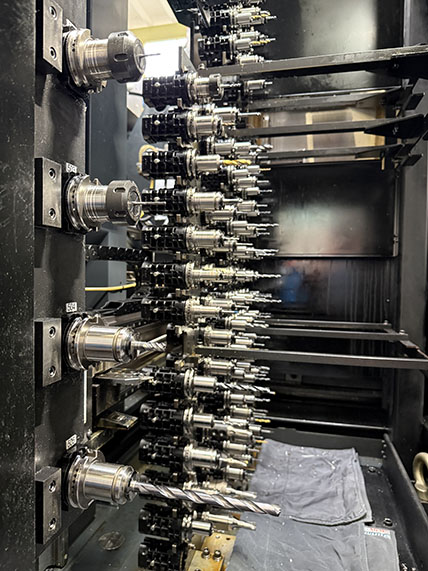
The strong involvement of employees was a key factor in implementing lean principles within the manufacturing cell. The focus was on consistent alignment with standardized processes, stable workflows, and continuous improvement (CIP). Many solutions were developed directly by the operators, critically reviewed in daily use, and continuously refined. These include ergonomically designed workstations with individually adapted tables and transport carts, clearly structured storage areas, and tool shadow boards in line with 5S methodology.
A valuable standardization
This systematic involvement of employees not only strengthens ownership of processes but also enables sustainable development of production in line with core lean principles such as waste reduction, transparency, and standardization. The result is robust, repeatable processes and measurable efficiency gains in daily operations.
It is clear that the decision to adopt the powRgrip® system was not made in isolation, but rather as an integral part of a holistic lean approach with the goal of harmonizing processes, minimizing setup times, and increasing productivity in the long term.
Another decisive advantage can be seen in the organization of production: as part of the so-called “mirroring” of a production line, consisting of two Okuma turning centers and one DMG milling center with an SK40 spindle, the powRgrip® system was consistently implemented. The goal was to create identical conditions across all machines. “Every employee should be able to operate every machine. Standardizing the toolholding systems is a key factor in achieving this,” emphasizes Knecht. A second powRgrip® clamping unit directly at the line further ensures minimal travel distances and maximum efficiency.
Especially in the service business, where delivery times are often critical, these optimizations have an immediate impact. Reduced setup times, high availability, and stable processes directly contribute to delivery performance.
A proven partnership
Burckhardt Compression has been supported by Vischer & Bolli AG for many years. The collaboration is characterized by high reliability, expert consulting, and broad product availability. The user-friendly online shop and scanning app, which enable fast and simple reordering, are also highly valued. “Delivery works flawlessly, the contacts are highly competent, and the quality is right—that’s what matters to us,” says Knecht.
This example from the service division at Burckhardt Compression clearly demonstrates the impact that modern toolholding systems can have on efficiency and process reliability in manufacturing. With powRgrip® and ER from REGO-FIX, not only has a technological change been implemented, but a significant contribution has also been made to the flexibility and overall performance of production.
© 2026 Vischer & Bolli AG – All rights reserved.